
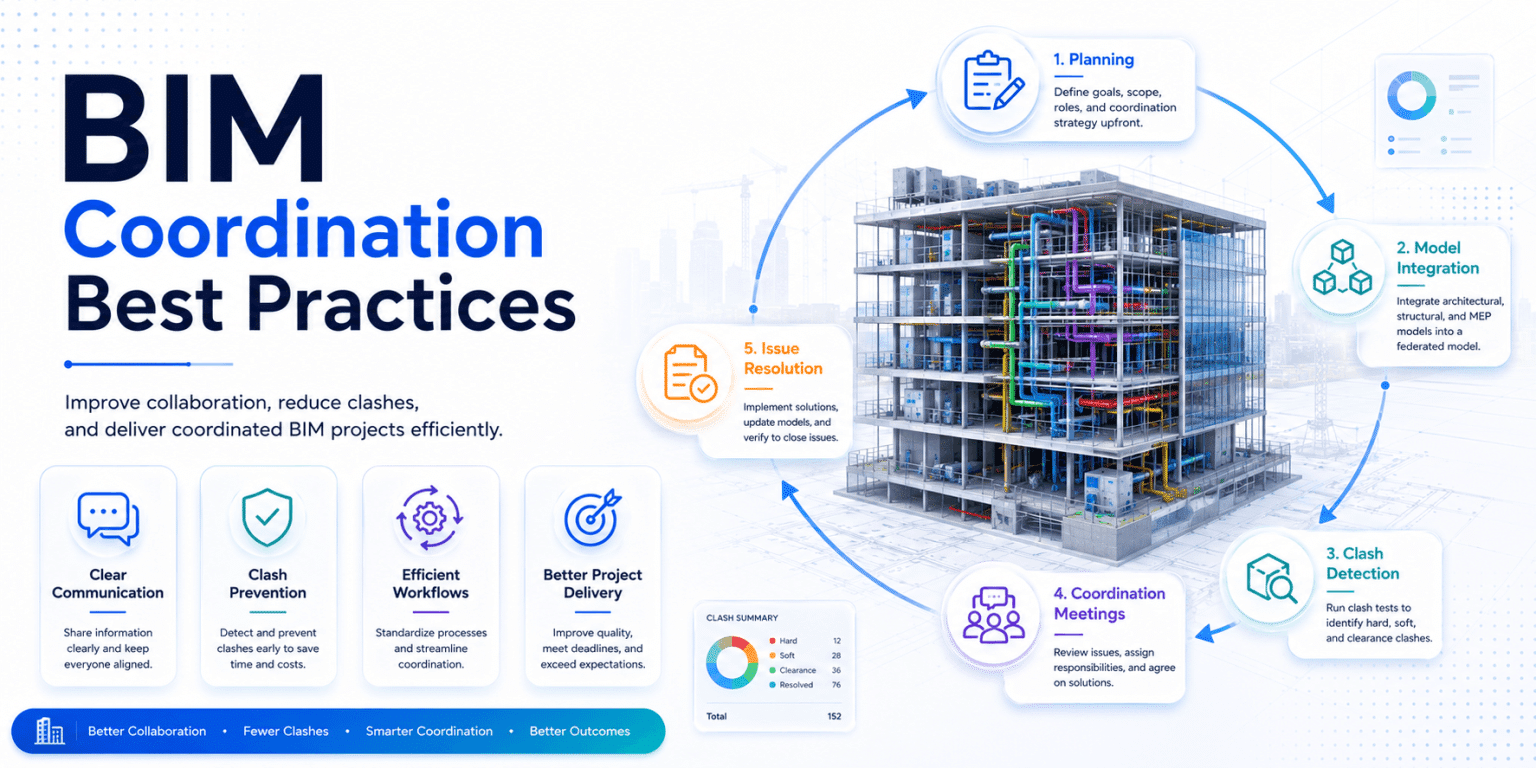
Ask most people on a construction project what BIM coordination means and they will give you a version of the same answer: it is the process of checking that models from different disciplines work together before anyone starts building. That description is not wrong. It captures only part of what effective coordination involves. Detecting clashes in a federated model is one step in a much broader process. Teams must manage how information flows between disciplines, determine what decisions get made and when, and maintain a shared understanding of something that continuously evolves. Getting that broader process right separates coordination that genuinely adds value from coordination that generates paperwork without improving outcomes.
What BIM Coordination Actually Covers
BIM coordination, in practice, refers to the structured management of spatial and technical information across multiple disciplines on a construction project. Its purpose is to ensure that design intent can be realised as a building, and that the people responsible for different aspects of that building work from compatible information at every stage.
This covers several overlapping activities. Geometric coordination is the most visible: teams combine architectural, structural, and MEP models into a federated model and review that combined model for conflicts, clashes, or spatial issues. But coordination also includes managing the sequence in which teams produce design information, agreeing on the level of detail models need to reach at different project stages, and establishing how changes in one discipline reach others who may be affected.
Effective BIM coordination is as much about communication as it is about technology. The software tools teams use for clash detection, model review, and issue tracking are enablers, not solutions in themselves. A project with sophisticated software and poorly managed information exchange produces worse outcomes than a project using simpler tools with a well-structured coordination process.
The Role of the Federated Model in BIM Coordination
The federated model is the core working artefact of BIM coordination. It aggregates individual discipline models into a single environment for review and analysis. Each discipline — architecture, structure, or one of the mechanical, electrical, and plumbing services — typically maintains its own authoring model in its own software. The federated model brings these together without modifying the source files.
The value of the federated model comes from its comprehensiveness. When all discipline models are current and correctly georeferenced, the federated model gives a realistic picture of how the building is developing as a whole. Clashes, spatial conflicts, and coordination issues that would be difficult to identify by reviewing drawings separately become much more visible when teams combine the models.
Managing the federated model well requires discipline from all contributors. When one team regularly provides outdated or incomplete models, the review process becomes unreliable. The coordination team ends up checking conditions that no longer reflect the current design. This wastes time and erodes confidence in the process. Establishing a regular model exchange cycle — with agreed deadlines and a clear understanding of what each model should contain at each stage — is one of the most practical steps a coordination lead can take.
Levels of Information and Why They Matter
One of the points of confusion that comes up frequently in BIM coordination is how much detail models need to contain, and at what stage. Teams sometimes discuss this in terms of Level of Development or Level of Detail. The precise definitions vary between standards and jurisdictions, so it is worth checking which framework applies on a given project rather than assuming a universal meaning.
The underlying principle is that models should contain the information necessary for the decisions that need making at each project stage — and not necessarily more. Early in design, when teams are still resolving major spatial decisions, highly detailed models can be counterproductive. They take longer to produce, are harder to update, and can create a false sense of resolution in areas where design intent is still developing.
Coordination Requirements Change Over Time
As the project moves towards construction, models need to be more precise. Contractors and fabricators use that information to determine quantities, sequence work, and in some cases drive manufacturing processes directly. A coordination process that treats all stages the same way — with the same review frequency and the same standards for model content — will either demand too much detail too early or fail to catch real problems before they become expensive.
Managing Clashes and BIM Coordination Issues
Clash detection is one of the more tangible outputs of BIM coordination. Running a clash test between discipline models identifies geometric conflicts: places where elements from two different disciplines occupy the same space, or come closer than a defined minimum clearance. Teams need to review, triage, and resolve these.
The challenge is that a clash test on a real project model often returns a large number of results. Not all of them represent genuine coordination problems. Some are false positives from modelling conventions, elements that intentionally overlap, or conditions teams already know about and are managing. A coordination lead working through a clash report needs to distinguish between issues that require design decisions and issues that are artefacts of how the models were set up.
Good issue management practice helps here. Coordination issues — whether they come from clash detection or visual review — need a consistent record: enough information to understand the problem and its location, assignment to the party responsible for resolving it, and tracking through to resolution. When teams manage this well, coordination meetings become more focused and productive. There is a shared record of what the group discussed, what decisions it made, and what remains outstanding.
The goal of coordination is not a model with zero clashes. It is a design that teams can build as intended, with the major technical and spatial issues identified and resolved before construction begins. Zero clashes can mean the coordination process was thorough and effective — or it can mean the models are incomplete and real problems have not yet surfaced. The difference matters, and experienced coordination leads learn to read the situation accordingly.
Information Exchange Between Organisations
On projects involving multiple organisations, managing information exchange is one of the more demanding aspects of coordination. Each organisation has its own authoring environment, its own workflows, and its own constraints on when and how it can share information. The coordination process needs to accommodate this reality without allowing it to become an excuse for poor communication.
Agreeing on model exchange formats early in the project is a practical starting point. IFC, the open standard for building model exchange maintained by buildingSMART International, provides a way to share geometric and property data between different software platforms without requiring all parties to use the same authoring tool. Whether IFC is the right choice depends on the specific tools and workflows involved. The quality of IFC output varies between platforms and between users, but it is worth understanding as an option for cross-platform BIM coordination.
Beyond format, the cadence of information exchange matters. A model exchange cycle that runs too infrequently means coordination reviews rely on stale information. Design changes remain invisible to other disciplines until they appear in drawings already under construction. Too frequent, and teams spend more time on model sharing administration than on actual design work. The right cadence depends on the pace of design change and the project programme, and it often needs adjustment as the project evolves.
How to Improve Your BIM Coordination Approach
For teams looking to strengthen their BIM coordination process, a few practical starting points tend to have a disproportionate effect.
The first is to establish clear ownership. Someone on the project — usually a BIM coordinator or information manager — should own the coordination process as a whole: setting up the federated model, running clash reviews, managing the issue register, and keeping the exchange cycle on track. When coordination is a shared responsibility with no clear lead, it tends to drift.
The second is to invest time at the start of the project defining the coordination protocol. This does not need to be a lengthy document. It should cover the key questions: how often teams will exchange models, in what format, to what level of detail, how they will record and track issues, and who has authority to close an issue once raised. Having these agreements in place before the first coordination review makes subsequent meetings much more efficient.
The third is to treat coordination reviews as design meetings rather than compliance exercises. The purpose of reviewing a federated model is to make better design decisions, not to generate a report proving the process was followed. When coordination reviews focus on real decisions, with the right people in the room and a clear agenda, they tend to be more useful and more efficient than when teams treat them as a tick-box activity.
People First, Tools Second
Looking back at projects where BIM coordination has worked well, the common factor is rarely the sophistication of the tools. It is the quality of working relationships between the people responsible for different parts of the design, and their willingness to share information openly and engage honestly with problems when they surface.
Good coordination software can make a capable team more efficient. It cannot make an unwilling team coordinate effectively. The technical skills required for BIM coordination — model management, clash detection, issue tracking — are learnable and increasingly well documented. The human skills — communicating clearly across disciplinary and organisational boundaries, managing disagreements about design decisions, keeping the process moving when information is incomplete — are harder to develop and more important to get right. They are also the reason why the most effective BIM coordinators tend to be people with deep project experience, not just strong software skills.
 English
 Swedish