
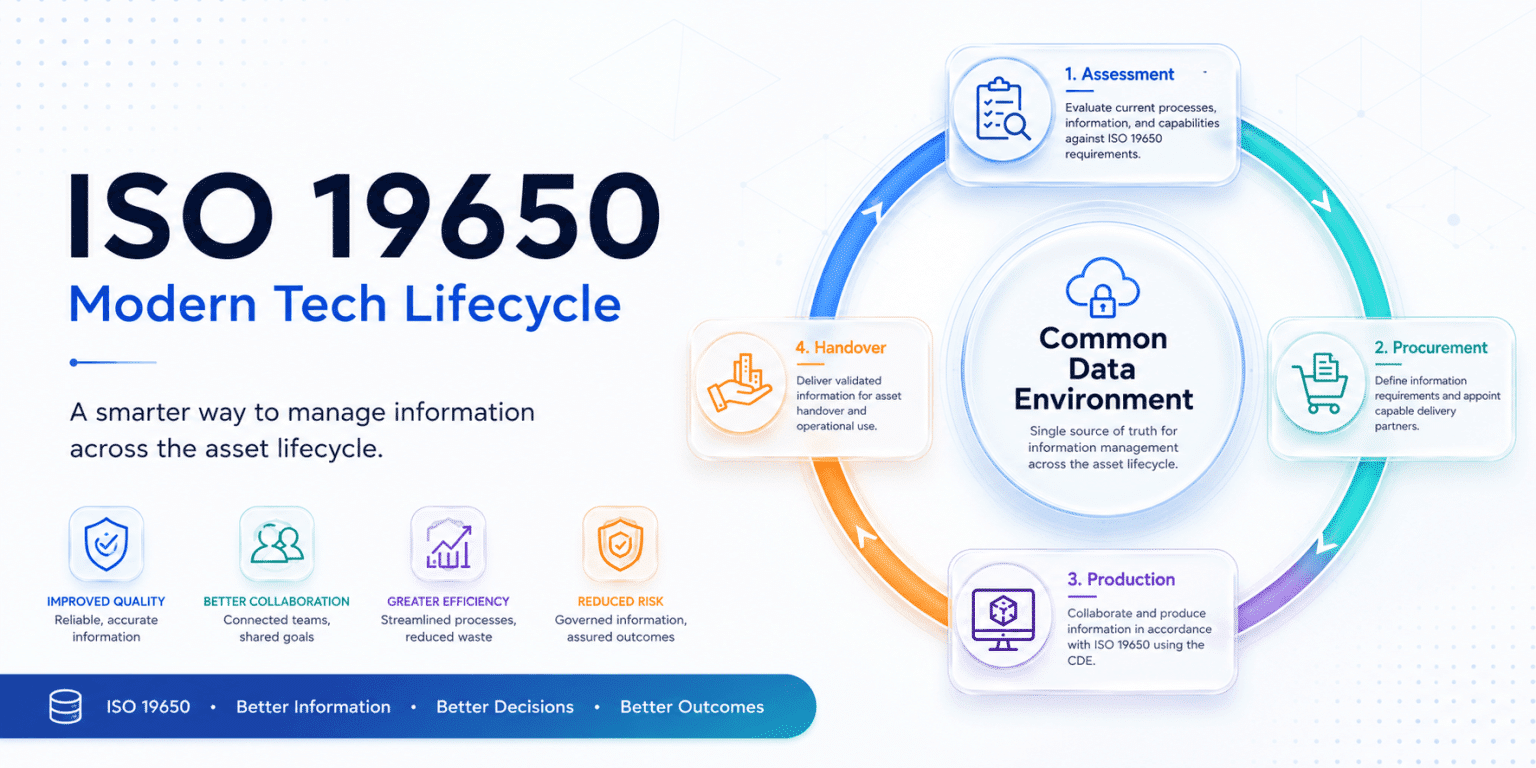
There is a moment on almost every construction project when someone asks a question that should have a straightforward answer. Nobody in the room can agree on it. Where is the latest version of this drawing? Which consultant has the current structural model? Who approved the change to that wall specification, and when? These are not complicated questions. On a project involving a dozen organisations, hundreds of deliverables, and a schedule measured in months or years, they become surprisingly difficult to answer reliably. ISO 19650 is a framework designed to make those questions easier to answer, consistently, across the project team.
What the Standard Actually Is
The international standard ISO 19650 defines how to manage information over the life cycle of built assets using Building Information Modelling. The International Organization for Standardization developed it, building on the earlier British Standard BS 1192 and PAS 1192 series. Those earlier standards had already been in use across the UK construction industry for several years. Parts 1 and 2 cover the concepts and principles of information management and the delivery phase of construction projects. Further parts address the operational phase, security-minded BIM, and other specialised areas.
At its core, ISO 19650 is not a software specification. It does not tell you which BIM platform to use or how to model a structural column. It provides a set of concepts and recommended practices for how information should be produced, shared, reviewed, and approved between organisations on the same project. The standard introduces consistent terminology, clear roles and responsibilities, and a structured process for managing information flow from project commission through to building handover.
The Terminology Worth Knowing
One of the first things people notice when they engage with ISO 19650 is that it introduces a specific vocabulary. Some of this terminology can feel formal at first, but it exists for a good reason. Construction projects regularly involve people from different countries, disciplines, and professional backgrounds. Agreed definitions reduce the chance of misunderstanding.
A few terms are worth understanding early. The appointing party is the organisation that commissions work, while the appointed party carries it out. This could be a client appointing a main contractor, or a main contractor appointing a subcontractor. The standard applies consistently at each level of the supply chain. The Common Data Environment, often abbreviated to CDE, is the agreed platform through which project information is shared and managed. It might be a cloud-based document management system, a dedicated BIM collaboration platform, or a more basic shared file structure, as long as it follows the workflow principles the standard describes.
Information requirements are another central concept. Before work begins, the appointing party defines what information they need, in what format, and by when. These requirements cascade down through the project. The client sets out their Asset Information Requirements. The project team translates these into an Organisational Information Requirement. Specific project deliverables are then captured in an Exchange Information Requirement. Everyone working on the project understands what they are expected to produce, and for whom, before they start.
Why Structured Information Management Matters
Fair to ask whether a formal framework is genuinely necessary, or simply bureaucracy for its own sake. The honest answer depends on project scale and complexity. The underlying problems the standard addresses are real, regardless of project size.
Unstructured information leads to bad decisions. A contractor may build from a drawing that has since been superseded. An engineer may model against spatial assumptions that changed two weeks ago. A facilities manager may receive a handover package that is missing critical operational data. These failures rarely stem from carelessness. They occur because nobody established a clear process for how information moves between teams and how its status is communicated.
ISO 19650 provides a structure that makes these failures less likely. When everyone on a project knows where approved information lives, how it is named, what review states it moves through, and who is responsible for each stage, coordination relies less on individual memory and informal communication. Errors are easier to detect and correct before they become expensive problems on site.
Clients who own and operate buildings over a long period gain an additional benefit. Information produced and managed according to a consistent standard is more likely to remain usable after project completion. A well-structured handover package, with verified asset data and properly named documentation, is far more useful for ongoing facilities management than a folder of unorganised files delivered on the last day.
How to Start Applying ISO 19650
Adopting ISO 19650 on a project does not require every team member to read the full standard. Someone within the project, or at least within each appointing organisation, needs to understand the framework well enough to set up the information management process correctly from the start.
A practical starting point is the Exchange Information Requirements. Before work begins, document what information is actually needed at each project stage, in what format, and to what level of detail. This single step removes a significant amount of ambiguity that typically builds up over the course of a project. It forces the appointing party to think carefully about what they will do with the information they are requesting. That often leads to more realistic and useful requirements than a generic BIM deliverables list.
The next step is establishing the Common Data Environment and agreeing on how it will be used. This includes naming conventions, folder structures, and the workflow for moving information between states. From work in progress, to shared for coordination, to approved for construction. The specific conventions matter less than the fact that everyone agrees and follows them consistently. A simple, well-understood system will always outperform a sophisticated one that half the team ignores.
Teams new to structured information management will make mistakes in the early stages. Files get named incorrectly. Review workflows get bypassed under schedule pressure. Some team members engage more than others. This is normal, and it does not mean the effort is not worthwhile. The value accumulates over time, particularly on longer or more complex projects where the consequences of information disorder become increasingly costly to manage.


 English
 Swedish