
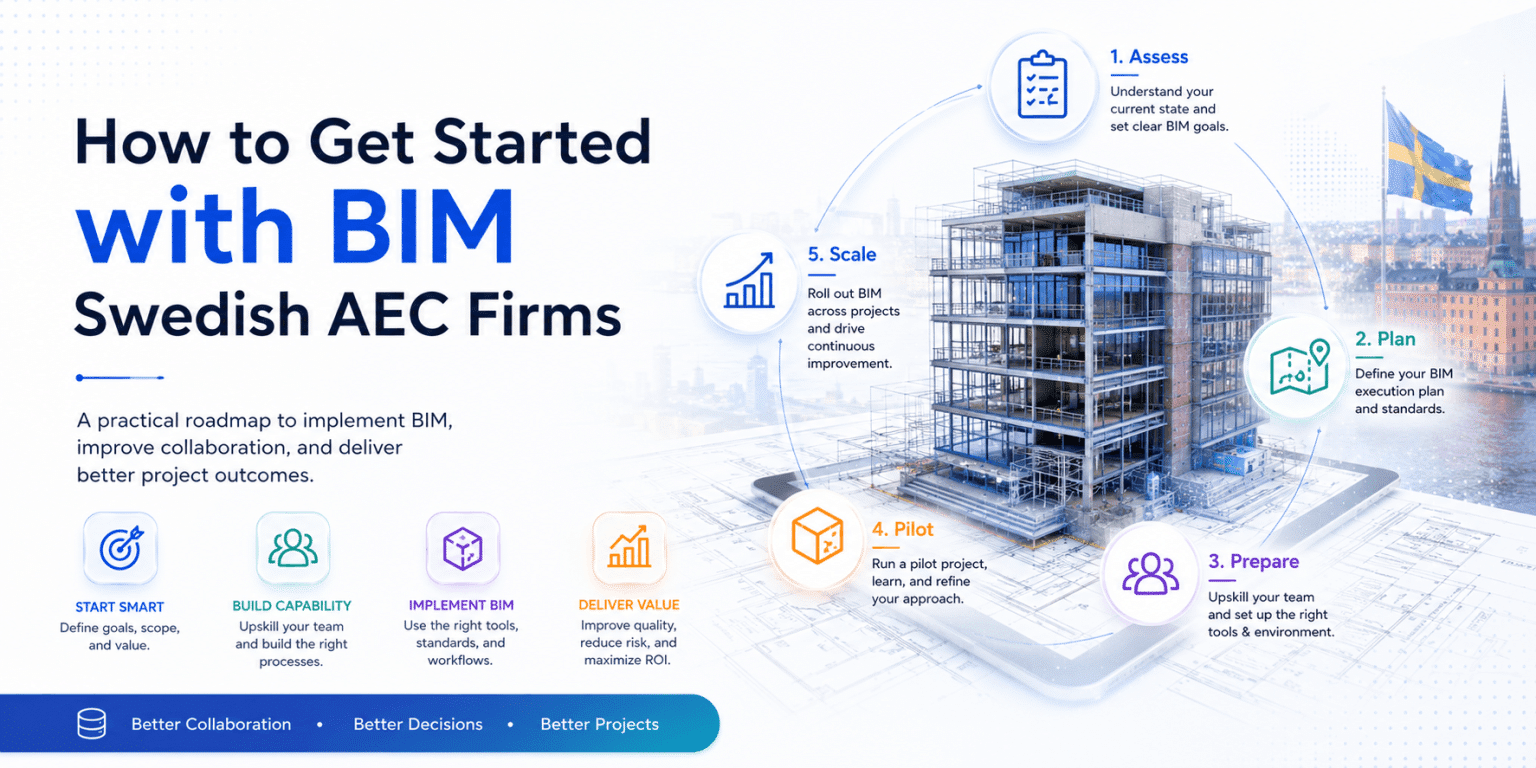
Getting started with BIM in Sweden is something most AEC firms know they need to do — but few have a clear roadmap for. The question that actually comes up in practice is: where do you start, and what does getting started with BIM in Sweden realistically look like for a firm that isn’t already deep into it?
This guide is written for architects, engineers, and construction professionals in Sweden who want a clear, grounded path. No overselling. The steps here reflect how BIM adoption actually works in practice, including the specific standards and context relevant to the Swedish market.
Step 1: Understand What BIM Actually Is (and Isn’t)
BIM is not a software. This is worth saying upfront because a lot of firms treat purchasing Revit or ArchiCAD as “implementing BIM.” That’s one piece of it, but not the whole picture.
BIM is a process for creating and managing building information throughout a project’s lifecycle. The 3D model is a byproduct. The value comes from structured information: material specifications, space data, cost estimates, and handover documentation. When firms understand this early, they make better decisions about tools, training, and workflows. The software question is secondary to the process and information management questions.
Step 2: Know the Swedish BIM Context
Getting started with BIM in Sweden means understanding the specific national landscape. A few things are worth knowing:
- Trafikverket requires BIM for infrastructure projects and is rolling out openBIM and IFC 4.3.
- Boverket is developing national BIM guidelines for public procurement, centred on ISO 19650.
- BIM Alliance Sweden is the primary body coordinating national BIM adoption and publishes useful guidance for firms at all stages.
Working on Swedish public projects increasingly requires the ability to use ISO 19650 frameworks and deliver IFC-based models. If your firm is considering public sector work, this is the standard to build toward.
Step 3: Assess Where Your Firm Currently Stands
Before getting started with BIM in Sweden on real projects, firms need to honestly audit their current state. Are you producing 2D drawings? Using 3D visualisation tools without structured data? Lacking standardised BIM Execution Plans (BEPs)? Skipping this assessment often leads to expensive technical debt later.
A simple audit covers three areas: current software and workflows, team familiarity with IFC and openBIM, and whether any previous projects have used a BEP or Common Data Environment.
Step 4: Pick a Tool and Commit to It
For Swedish firms, the main options are:
- Revit — dominant for large multidisciplinary public and commercial projects.
- ArchiCAD — strong for architecture-focused studios with good IFC export capabilities.
- Tekla Structures — the standard for structural detailing.
The key is to pick one and use it consistently on real projects. Running parallel 2D/3D workflows defeats the purpose of BIM adoption.
Step 5: Run a Pilot Project
Choose one manageable project to serve as a learning environment. Goals should include: producing full documentation from the model, exporting and verifying IFC files, coordinating with at least one other discipline, and drafting a basic BIM Execution Plan.
A pilot project is the fastest way to close the gap between theory and practice when getting started with BIM in Sweden. It surfaces the real problems — naming conventions, model quality, coordination workflows — in a lower-stakes environment.
Step 6: Build Your BIM Execution Plan Process
A BEP defines project roles, deliverables, and file formats. Many Swedish firms struggle at this stage due to a lack of standard BEPs. Using the ISO 19650 framework — specifically Exchange Information Requirements (EIR), the BEP, and a Common Data Environment (CDE) — significantly improves coordination outcomes. For a deeper look at how this works, read our practical guide to ISO 19650.
Step 7: Invest in the Right Training
Beyond basic software training, firms getting started with BIM in Sweden should prioritise:
- IFC and openBIM workflows
- Model checking tools like Solibri
- ISO 19650 fundamentals
- BIM coordination and clash detection processes
Step 8: Set Realistic Expectations
BIM implementation is a long-term transition. A small firm typically requires 12–18 months for competent BIM delivery. Medium-sized firms may need 2–3 years. Success depends on treating BIM as a fundamental change in information management — not a simple IT installation.
Firms that approach getting started with BIM in Sweden as a process change rather than a software purchase consistently outperform those that don’t.
Where to Start Tomorrow
- Download a free BIM viewer (Solibri Anywhere or BIMvision) to examine IFC files.
- Review BIM Alliance Sweden’s introductory materials.
- Use a BIM tool on one upcoming project, even if only partially.
- Set one concrete goal — such as producing a schedule directly from the model.

 English
 Swedish