
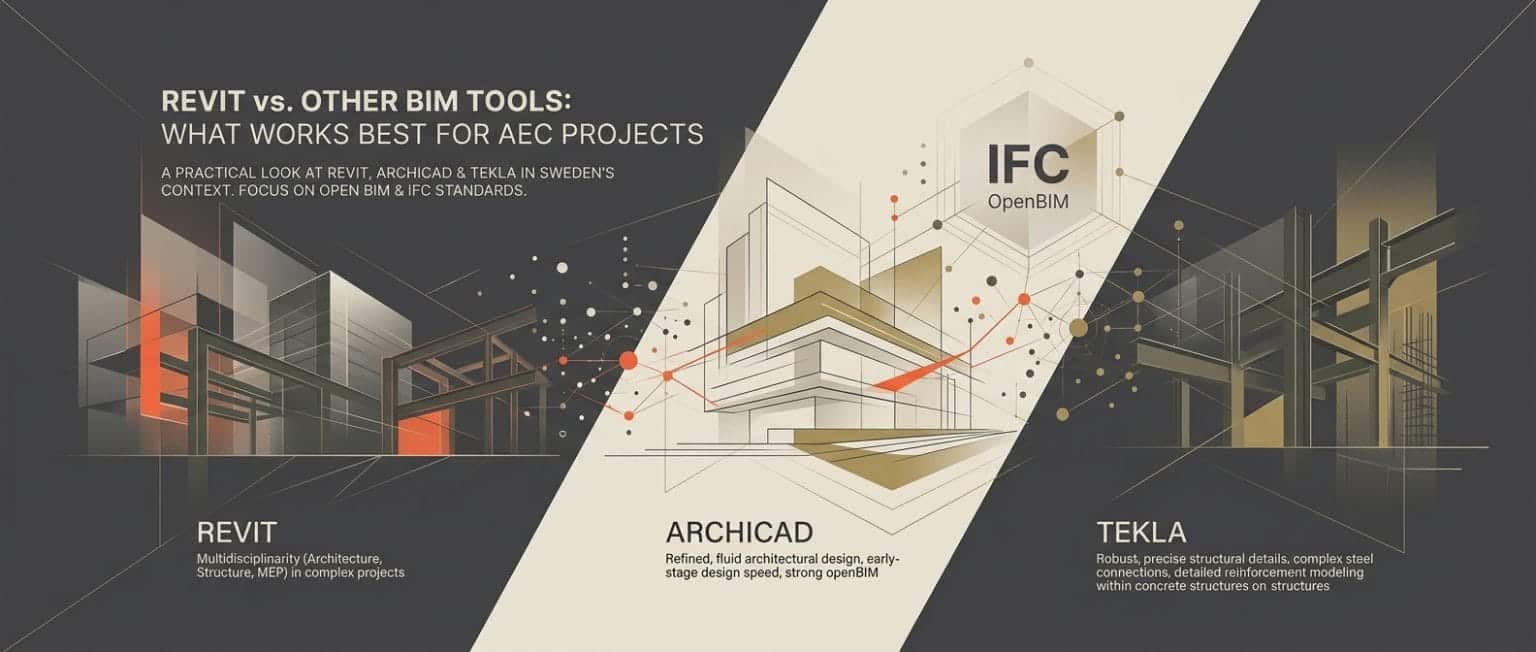
If you work in the Swedish AEC industry, you’ve probably had this conversation before: someone on the team insists on Revit, someone else prefers ArchiCAD, and the structural engineer is deep in Tekla. Everyone has a reason. The question is — what actually makes sense for Swedish projects, given local standards, procurement requirements, and how firms here actually work?
This post breaks it down without the vendor marketing. Just a practical look at the tools, what they’re good at, and where they fall short in the Swedish context.
The Swedish BIM Landscape: What You Need to Know First
Before comparing tools, context matters. Sweden has been pushing BIM adoption seriously since Trafikverket (the Swedish Transport Administration) mandated BIM in all new investment procurements starting in 2015. More recently, Boverket was tasked by the government in 2023 with developing national BIM guidelines for public procurement, aligned with ISO 19650 and open formats.
The direction is clear: open BIM, IFC-based deliverables, and interoperability are becoming the baseline — not a bonus. Trafikverket started its phased rollout of openBIM and IFC for road and rail projects in 2024. This shapes which tools are viable long-term on Swedish public projects.
What this means practically: any tool you use needs to export clean, reliable IFC files. That single requirement already filters a lot of decisions.
Revit: Still the Default for Multidisciplinary Projects
Revit remains the most widely used BIM authoring tool across Swedish AEC firms, particularly on larger projects involving architecture, structural, and MEP disciplines together. The reason is straightforward: it handles cross-discipline coordination better than most alternatives.
When architects, structural engineers, and MEP consultants are all working on the same building, Revit’s shared model environment and clash detection workflows reduce coordination headaches significantly. Autodesk’s BIM Collaborate Pro (formerly BIM 360 Design) has made cloud-based worksharing more practical for distributed Swedish teams.
Where Revit works well in Sweden:
- Large public projects with multiple disciplines (hospitals, schools, housing blocks)
- Teams already in the Autodesk ecosystem using Navisworks for coordination
- Projects requiring detailed documentation and automated drawing sets
- Firms that need to comply with ISO 19650 workflows — Revit integrates well with Autodesk’s CDE tools
Where it gets frustrating:
- The subscription cost is high. For smaller Swedish firms or freelancers, the AEC Collection price is a real concern.
- IFC export from Revit has historically been inconsistent. It has improved with IFC4 support, but you still need to configure exports carefully. Don’t assume a default export is clean.
- It’s slower and heavier than ArchiCAD for pure architecture work. Loading large models can be painful.
- Learning curve is steep for new team members.
ArchiCAD: The Architect’s Tool, and It Shows
ArchiCAD has a loyal user base in Sweden, particularly among architecture-focused studios. It’s faster to work with for early-stage design, the interface is more intuitive, and its openBIM credentials are genuinely strong — Graphisoft has been an active bSI (buildingSMART International) member for years.
ArchiCAD’s IFC export is generally more reliable out of the box than Revit’s. For Swedish projects where openBIM compliance matters, this is a real advantage. The BIMcloud platform also provides solid real-time collaboration for teams working on the same model.
Where ArchiCAD makes sense:
- Architecture-led studios doing design-heavy work where speed and creativity matter
- Smaller firms or individual consultants who don’t need the full Autodesk stack
- Projects where openBIM and clean IFC delivery is a priority from day one
- Firms that want a lower cost entry point with solid BIM capability
The honest limitations:
- The structural and MEP capabilities are weaker than Revit’s. For fully integrated multidisciplinary models, you’ll hit limits.
- The add-on and plugin ecosystem is smaller. If your workflow requires specific integrations, check compatibility first.
- In Sweden’s large-scale public sector projects, where Revit tends to dominate, coordination with other firms using Revit can create friction — even with IFC as the exchange format, some information gets lost in translation.
Tekla Structures: The Structural Engineer’s Standard
Tekla is not really competing with Revit or ArchiCAD for general BIM use. It occupies a specific, well-defined space: detailed structural modeling, steel and concrete detailing, fabrication output, and construction sequencing. For those workflows, it’s in a league of its own.
On Swedish infrastructure and heavy construction projects — bridges, industrial buildings, large concrete structures — Tekla is often the tool of choice for structural teams. It integrates with Revit and AutoCAD, and its IFC support is solid for the structural domain.
When to use Tekla in a Swedish project:
- Steel fabrication projects where CNC output is needed
- Large concrete structures requiring detailed reinforcement modeling
- Infrastructure projects (bridges, tunnels) run by contractors
- When the structural engineer is the lead discipline and needs fabrication-ready models
What it’s not for:
- Architectural design — there’s essentially no workflow here
- MEP coordination
- Firms that need one tool to cover multiple disciplines
Other Tools Worth Mentioning
Vectorworks has some presence in Swedish landscape architecture and smaller design practices. It’s capable, but not widely used in the broader AEC market here.
Bentley OpenBuildings Designer is used on some large infrastructure-adjacent building projects, particularly where Bentley’s infrastructure ecosystem (OpenRoads, OpenBridge) is already in play. Not a common choice for standard building projects.
Solibri deserves a mention even though it’s a model checker, not an authoring tool. It’s widely used in Sweden for IFC-based model quality control and is practically standard in openBIM workflows on public projects.
The Practical Recommendation
There’s no single right answer, but there are sensible defaults based on project type and team composition:
- Multidisciplinary building projects (public sector, housing, commercial): Revit remains the safest choice for coordination, especially when multiple firms are involved. Make sure IFC exports are configured properly.
- Architecture-led studios doing design and documentation: ArchiCAD is a strong, cost-effective choice with solid openBIM credentials.
- Structural detailing and fabrication: Tekla is the industry standard and not really replaceable for these workflows.
- If you’re working on Swedish public infrastructure projects: Align with Trafikverket’s openBIM and IFC 4.3 direction. The tool matters less than whether you can deliver clean, validated IFC files.
One thing that’s becoming increasingly clear in the Swedish market: the tool debate matters less than it used to. As IFC-based workflows mature and ISO 19650 becomes the operational standard, what counts is whether your team can deliver well-structured, information-rich models — regardless of which software created them.
That said, tool choice still affects day-to-day efficiency, coordination quality, and cost. Choose based on your actual project requirements, not on what’s most familiar or what a software vendor is currently promoting.

 English
 Swedish